Flexible Classroom Design Gives Every Student a Voice, Says Speech Pathologist
By Alicia Springer, M.Ed.
In this series from Artcobell, a leader in classroom furniture for 60 years, we review strategies for thoughtful classroom design from the perspectives of various stakeholders. In part one, an educator shared how basic design principles can benefit all learners, and in part two, an occupational therapist provided input.
In part three, speech-language pathologist Crystal Martinez discusses how designers can create spaces for every voice. The following has been adapted and condensed from the original article.
Designing classrooms that foster communication often brings to mind dialogue and discussion. But for many students, communication looks and sounds very different—and the spaces we create can either amplify or silence their voices.
That’s the daily focus for Crystal Martinez, a speech-language pathologist with Fresno County Superintendent of Schools. For more than a decade, she has supported students with moderate-to-severe disabilities, and she specializes in augmentative and alternative communication (AAC), which helps nonverbal students express themselves. Her work highlights how communication design is as essential as furniture, lighting, and acoustics when building inclusive learning environments. She believes design can send the all-important message: “Your voice belongs here.”
Every Surface Can Speak
One of Martinez’s most effective tools is simple: single-button, wall-mounted voice output devices that play messages like “Hello” or “Goodbye.” They’re placed along hallways or near restrooms, each with an image or symbol.
“At first, I wasn’t a fan,” she says. “They felt so limited! But when we started mounting them low on walls so wheelchair users could reach them, I saw how powerful they became. Eventually, students began pressing them independently. What started as a staff-modeled behavior became their own form of communication.”
These “community buttons” show that accessibility doesn’t have to be complex, but it must be intentional. Placement, visibility, and physical reach determine whether a tool becomes part of a student’s routine.
Space for Connection, Not Just Devices
For Martinez, the priority isn’t the device itself—it’s access. AAC systems range from laminated communication boards to iPads running apps like Proloquo2Go, but they only work when they’re close at hand.
“The goal is for students to have their device with them all the time,” she explains. “But that’s tricky when you have a classroom full of different behaviors, limited space, or safety concerns.”
Her solution? Improvised, flexible storage. Martinez has attached communication boards to desks with hooks and zip ties. She imagines classroom furniture with built-in cubbies or side compartments where devices can stay protected but reachable.
Even small tweaks—clips for boards, inset holders for cards—can turn a tool into a daily communication aid.
Adaptive Design for Adaptive Learning
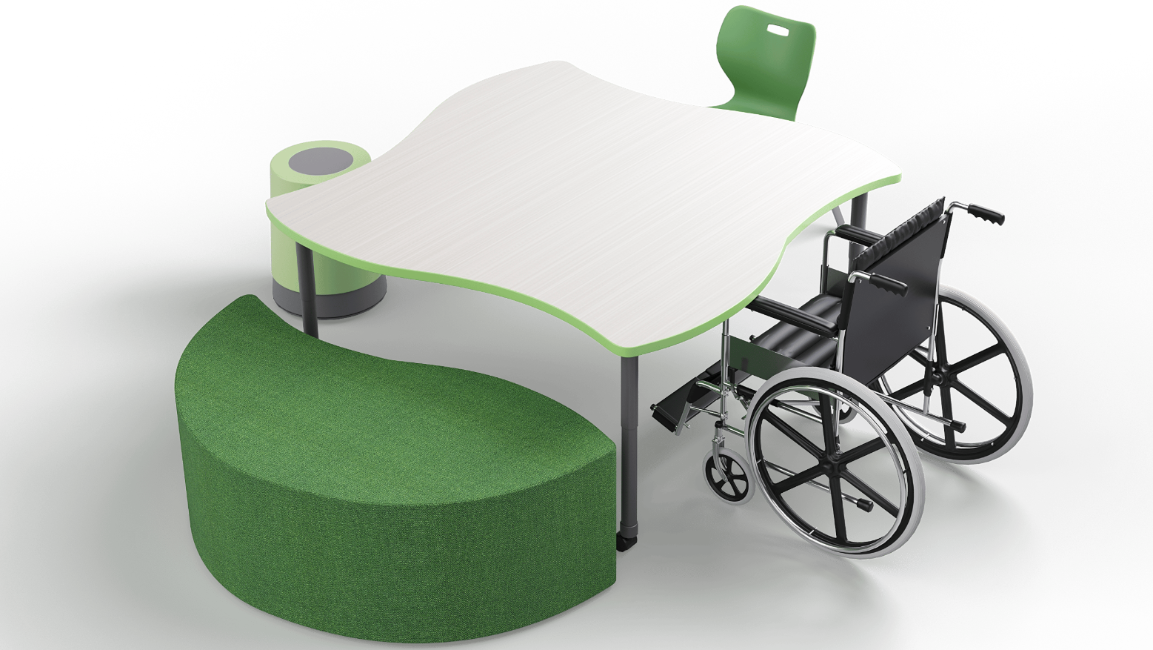
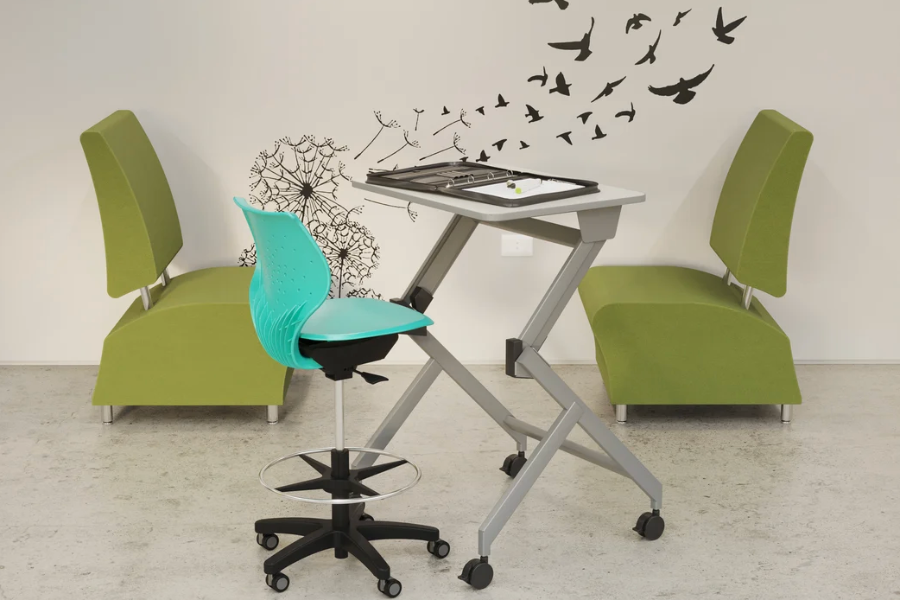
Not all students interact with spaces in the same way. Martinez collaborates with specialists to adapt setups for students using eye-gaze communication systems or wheelchairs. “In one case, I found a slim, adjustable-height table on wheels that we could move around the classroom,” she says. It allowed a student to communicate regardless of posture changes.
Lighting matters, too. Some students find bright fluorescent lighting overwhelming—especially when seated beneath them. “We cover the lights with green mesh to create a calming effect,” she notes.
A Vision for Truly Communicative Classrooms
Martinez’s ideal classroom would include adaptive seating, swivel tables, and touch-interactive screens. But her dream goes further. “I’d love every classroom to have a communication board, just like the ones we’ve created for cafeterias,” she says. In her vision, communication tools become standard fixtures, and everyone in the school community models inclusive interaction, creating a culture where every voice belongs.
Read the rest of the entries in this series, “Classroom Design for All Learners”:
And look out for the fourth and final installment: Through the Eyes of a Special Education Teacher (coming soon).